Key takeaways from my first field campaign
This year, I had the incredible opportunity to go 150 km above the Arctic Circle in Northern Finland to conduct field measurements on atmospheric dispersion. It was such an intense experience, and I'll never forget it! Apart from the amazing professional experience, I learned so much about myself. It was a whirlwind of emotions and feelings, but in a good way!
I have to admit, before the campaign I was already feeling a bit nervous. I did my best to prepare for it, but I knew it would be a more stressful environment than what I'm used to. After all, the experiments have to go right, we need to troubleshoot on site, and there's a lot of money and time on the line! Also, the nearest hospital was three hours away, which meant that if something happened to any of us, it would take us six hours to get full medical attention. On top of that, I was already feeling stressed about everything that could go wrong.
These are once-in-a-lifetime opportunities, and even though it's totally normal to feel nervous and overwhelmed, it's important to embrace the excitement and enjoy the experience (Reindeer everywhere!). It's intense, and it requires a lot of mental resilience, creativity, and adaptability.
Here are the key takeaways from the campaign:
Telecommunications is a real thing! I honestly didn't see that one coming. I'm used to working in the lab with a couple of instruments at a time, hooked up to a wire that goes to the computer. In the field, we used up to 20 sensors at once, with each sending a signal that was received by a receiver connected to two antennae. We noticed a big difference in how the antennae performed when they were placed, for instance, on top of a car roof versus a small metallic surface. This is a pretty simple concept that we all know in theory, but when you're not used to working with these kinds of instruments, it can be a big detail that messes up your experiments. Also, having so many instruments working at once at the same frequency led to some broadband issues, where there was an upper limit on the number of sondes we could have working at once.
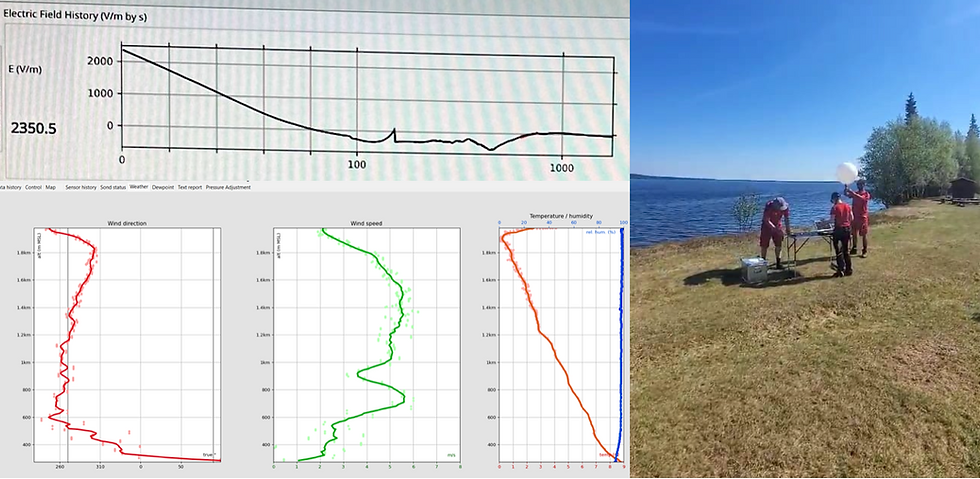
What I learned from books is also real! I still get a great feeling of satisfaction every time I see that what I have learned is real. For instance, we conducted live readings of the electrical field on the field site. It was incredible to see the data in real time during a storm. We released some radiosondes, and since I'm not from the meteorological community, it was very satisfying to see real-time data of the atmosphere (relative humidity, velocity and temperature).
What could go wrong, did go wrong. As they say, things never go as planned. Fortunately, we planned for this. We were always asked to have a plan A, B, C, …, Z. This made me think of possible scenarios and how we would do to solve them in the field. Some scenarios happened, some didn't, but we had a starting point on where we could start to implement a solution. In the end, we had to adapt and remain creative, which brings me to the next point.
Creativity is the key! When we're out in the field, we don't have an army of technicians or all the lab equipment we normally need. So if we need to do something quick, we need to think in terms of what we have available, or what we can buy in the grocery store. This was a fun experience; it felt like doing experiments with whatever we had at home.
Every minute matters. We've got to make the most of the time we have, because three weeks go by really quickly. You want to make the most of every minute, so it's important to manage your time effectively. I realized midway through the campaign that I had to get my experiments done right away. That meant that sometimes I couldn't spend time on the tiniest details and I just had to get started, even if I felt like I (or the experiment) wasn't ready. I had to let go of the small imperfections and hope for the best. That makes everything you do more urgent, but it's important to stay calm so that things don't go wrong because of human error caused by impatience.
Frustration is an almost constant feeling, but it is worth it in the end. As I mentioned, there were a lot of challenges along the way, which led us to think outside the box and adapt. This led to feelings of frustration and stress, and at times it was challenging to maintain a consistent and sustainable pace. There are only so many ways things can go wrong, and I feel like we hit that limit by midway through the campaign (spoiler alert: things never stopped going wrong one way or another!). But once we got everything solved and saw the experiment run (see the video below), I felt a huge sense of satisfaction, and I couldn't wait to get back to analyze the data!
Teamwork! I knew I'd get along with my colleagues, as we'd be relying on each other during those three weeks, but I never expected to get along so well with them or to work so well as a team. We faced some pretty challenging and occasionally risky situations on the field, but we all powered through together, each with our own specific role, and we all made it through. We supported each other and helped each other out, and there was a feeling of elation and even adrenaline whenever we achieved something hard. We had barbecues pretty often, and it was great to feel the camaraderie and how we could always make a fun situation out of everything. The highlight activity was lumberjacking!
Sharing is caring. This one belongs to the kindergarten book, but it is nice to have a reminder every once in a while. After living with my colleagues (most of whom I can call friends now) in a tiny hut, and spending literally all the time with them, you start to think less of your personal belongings and start sharing everything. We shared our time, our food, our moments and just about everything. If there was anyone that needed anything (toothpaste, sunscreen, or anything), we would all pitch in and help.
It is a very weird experience. There’s no other way to put it. It is weird. I woke up every day already feeling tired. I had breakfast with my cabin mates, then went to work. We worked for four hours non-stop, had a quick lunch, then kept on working for another six to eight hours. We came back to the cabin, showered, ate, and went to sleep. Our lives were centered around the campaign, and we didn't have much else to do (or the time to do so). There was no time for leisure reading, hiking, or watching TV (except for a few exceptions). I found it strange when it stopped feeling strange. At first, I was trying to fit in some personal time, but after a while (about five or seven days), I just started going through the motions. And I should mention that there was constant daylight. That was great, but still strange because we had no concept of nighttime, so we just kept working as if it was always 3 p.m.
We still need to look after ourselves. I made sure to take care of myself while I was there. I brought my yoga mat, tried to fit in a couple of workouts (not as many as I would have liked), took care of my meals, and tried to sleep as much as I could. This was really important, because we were under a lot of pressure and there were so many things going on that sometimes we didn't even want to cook or we might even forget to eat. But if I hadn't eaten as well as I did or taken care of my mental health, I don't know if I could have made it through.
We can thrive from stress. I know I mentioned it a lot, but it's tough to really capture how stressful everything was. Even before we started the campaign, we were already feeling the pressure from all the preparations. In the field, it was a different kind of stress. It's the stress of wanting your experiments to go well. It's the stress of only having work to think about. It might be the stress of spending 24 hours a day, 7 days a week, with people (for all the introverts out there!). In my case, I learned to live with it, and it was a great learning experience. I learned how to work in a different environment with different people and under pressure. And you can actually thrive from it!
I made it through!
P.S.: I concentrated on the “meta” aspect of the campaign (feelings, situations, etc). In terms of scientific knowledge, I learned a lot about clouds, the atmospheric boundary layer, signal reception and transmission, “real-life” turbulence, instrumentation, problem-solving, fast data analysis, and the list goes on.

Comments